Sunday, April 20, 2025

High School Swimmer

 In high school I tried out for the football team.  That experiment, in August, lasted for one day.  100 degree temperatures on the gridiron is not my idea of sport.  So, I made the only rational choice; a swimming pool of high school aged youth in speedos.  It was a springtime sport, and sometimes a winter sport.  Apparently the season depended on the whim of the athletic director.

I liked being in the pool and sometimes our coach instructed us to hold our arms out while fellow swimmers lay across them.  This was intended to improve our form, but I just enjoyed it.

In 1971, I graduated from high school and while in college I came to become more conscious of my sexual orientation.  There were lots of little clues: I enjoyed watching out my window as the boy who lived across the mall undressed for the night.  I picked up a piece of gay porn from the trash and treasured it for months.  It seems difficult to describe my experience to a post internet reader but I had a lot to learn and no easy way to learn it.  I have read stories about farm boys who found other boys on the farm.  Mine was not so easy.

Many years later I give thanks to my young friends on the swim team and the many other awkward, friendly experiences that taught me the joys of physical affection.

Monday, December 21, 2015

Kerry Takes Off

For some years that I was on the Varsity Swim Team, our season was a winter sport, so we put our suits and sweats on in the Locker Room behind the football grandstand then would cross the football field to the pool which was nicely heated and steaming.  One particular afternoon as we were ready for practice to begin, the school buses were lined up at the curb, just a few feet from the fence to the swimming pool.  It was crisp out, and the pool was steaming a little bit, so as quickly as possible, we shed our sweats.

 Kerry was a young swimmer with wide shoulders and a slim waist.  He had what would be called an Adonis physique.  But Adonis was not endowed with a lot of muscle between his ears, so it was not all that surprising, when he got up on the block and stripped off his sweats, that he quickly realized that he had forgotten to put on his swim suit.  His nudity was not lost on the kids waiting in the buses.  With cheers from the buses, and a cold wisp of air, Kerry dove into the pool.

While he was Eddie's little brother, he was never called "little" by his classmates after that.


Thursday, November 12, 2015

Getting around... with a little help from my friends


I spent some time in New York City recently.  My favorite mode of transportation were the buses of the Metropolitan Transit Authority (MTA).  The ladies and gentlemen who drive these buses work miracles when it comes to navigating through the traffic.  They never hit anybody, they never ran over anybody and they honked their horns every 15 seconds.  Because I was in a motorized wheelchair, the bus driver had to deploy an electronic ramp either at the front of, or in the middle of, the bus.  Then everybody waiting to get on had to step aside while I drove up the ramp, the bus driver took time to see that I was situated and belted in, then resumed the boarding of the other passengers.  It was as if someone walked up to you in the middle of your work day and said, "stop!  I have to help an old lady across the street."  Two miraculous events require mention.  One: The crowd of New Yorkers waiting to board stood patiently aside while I got on the bus.  And two: the bus drivers were all gracious, competent and welcoming as they were getting me strapped down.  Then the regular New Yorkers boarded the bus.  I wondered if the bus drivers had special ADA classes.  But then, I wondered if the whole city of New York had ADA classes.  Because, when do you get a whole crowd of New Yorkers to stand aside patiently?  On one occasion, I was the second chair in the bus, so everyone had to go through this maneuver twice.  

The thing every passenger needs to remember as they board the bus is their destination.  But I am not as accomplished as a regular New Yorker.  So my husband would whisper our destination in my ear as we got on the bus, and if I was fortunate, I could remember it for the 20 seconds before the bus driver asked me for it.  On one occasion, when I could not remember what to tell the bus driver about our itinerary, I shouted out to Tom, "WHERE AM I GOING?"  I guess I have to consider myself lucky that Tom and I were not arrested as part of some worldwide gimp slave trade.

After our New York adventure we returned to San Diego.  The flight arrived at 10 p.m., and we boarded a city bus right at the terminal.  The bus driver said, "Hi, welcome aboard.  I think I have seen you before."  I am not sure if that was true or if he was speaking for his brothers and sisters in New York.

Thursday, June 27, 2013


The jacaranda is a large deciduous tree with fine-textured, fern-like pinnate leaves. Young trees are upright but assume an irregular branching pattern that produces beautifully asymmetric open crowns as the trees age. From April to June (depending on species and location) the tree covers itself with showy trumpet shaped flowers that are about 1.5 inches wide and are arranged in panicles (pyramid shaped clusters) that grow at the tips of branches.

The blooms of the Jacaranda tree in San Diego are a beautiful violet color. At this time of year, the Jacaranda trees that line the streets are dropping their blooms and creating purple pathways of our streets and side walks. Purple has been a favorite color of gay people from Oscar Wilde to Harvey Milk. There are stories of men who wore purple socks to discreetly signal to each other in the early 20th century. It seems only appropriate that the Jacaranda would break forth with purple blooms in San Diego this time of year while the Supreme Court makes its landmark decision upholding gay marriage in California. I can believe that everyone wants to get on the bandwagon (except Michele Bachmann) and celebrate the right to marry!

Tuesday, November 8, 2011

Tari


Tari Lennon died last month; these are some words I shared at her service.

I met her 30 years ago, in a class at Claremont School of Theology. She breezed in, wearing a red wool cape and a matching red fedora. She was serving as the sole minister at a small UCC church in Thousand Oaks. She had received her Masters in Divinity from Union Seminary in New York years earlier, studying with Reinhold Niebuhr and Paul Tillich. She was taking some additional coursework at Claremont to complete a doctorate. I was enthralled by her ability to speak and capture the imagination of her listeners. Ours was a class about the use of story in the Scriptures, and Tari told the story of Ruth and Naomi, in ways we had never heard before.

We were in that class together for a semester and when it ended she and I talked about working together. She invited me to Thousand Oaks to meet a few people. So I drove up for what I thought was an afternoon meeting, which turned into an evening potluck and a congregational meeting. By the end of the evening, the congregation was inviting me to be the second person on their ministerial staff. That was sort of the way things happened with Tari, a meeting turned into a celebration, which turned into a hootenanny! And a job.

When Tari found out how much I was paying for a studio apartment in Thousand Oaks, she insisted I come live in her five-bedroom house with her. I was hesitant and wanted to guard my privacy, but I could see I was going to run out of money at those rental rates. So I moved into 3709 Consuelo. During the five years I was there we had several other occupants; we had a foster child named Casey, who stole the car one night. Hope Badner lived with us for a while, which was a delight. We made a heck of a little family, eating popcorn with parmesan cheese and watching late night movies on TV.

Tari took a sabbatical and did some studying on the East Coast; I flew back east to drive with her home. We stopped in Akron to visit Tari’s parents, Tilford and Ethel. I had heard stories of Ethel and Til, so I wasn’t looking forward to meeting them. We survived, and we escaped to continue our trip west. Fortunately, late in life, Tari reconnected with her sister, Corinne, and I know it was a great comfort to her.

After her time in Thousand Oaks, she served the Congregational Church in Laguna.

I know she made some good friends in Laguna; some of them are here today.

I'm something of a quiet person; I don't make too many waves. Spending time with Tari was always a good antidote, she had a talent for rustling up excitement. There were times in Thousand Oaks when she would drive up to my office in the late afternoon and ask ‘you want to go to dinner?’ If I said okay we might be off to Los Angeles for Indian food and a little known film. Five hours later we’d finally get home, and that's how the adventure would go.

I was so happy when Tari and Norma decided to combine households. I could just tell that Norma was one of those people who in the whirlwind of excitement, could remember where she put the car keys. They were a good team together, loving and careful, and laughing often

I will miss Tari, her perceptive political questions, her laugh, her big warm embrace. Have a good rest Cynthia Anne, you deserve it.

Thursday, July 21, 2011

The Oscars

Several years ago, Tom and I got to go to the Academy Awards presentation at the Shrine Auditorium thanks to my brother Ric. We both wore our black tuxedos (I bought mine at a church rummage sale and it was in surprisingly good shape, just a little hole in the pocket.) We walked up the red carpet and into the auditorium. I could hear the people in the bleachers outside pointing and asking, "are they somebody?" Once inside the grand foyer we mixed easily with the honored guests. We saw Walter Matthau and Jack Lemmon, hanging onto each other as they stumbled to their seats. Tom bumped into Lynn Redgrave, literally. They both almost landed on the floor. This is in the days before Lynn had started Weight Watchers and was a more treacherous wrestling opponent.

Our glamorous evening was before the Academy had arranged for its new Kodak Theater on Hollywood Boulevard. The Shrine comprises the single largest proscenium style stage in North America providing more than 6300 seats. Over 60 years old, the Shrine is recognized as a historical monument. The original auditorium was completed in 1906 and burned to the ground on January 11, 1920. It took six years for the new auditorium to be completely rebuilt on the same site as the original.

Tom and I found our seats and enjoyed the show. Watching the Oscars in person is less convenient than watching them at home. You can’t pop up and make a snack whenever you like. During the commercial breaks, the lights go off on the stage and everything comes to a halt. You are warned about moving around during these breaks. People called seat warmers are scurrying to fill the seats of stars who get up for a restroom break. After his run-in with Ms. Redgrave, Tom was nervous about getting knocked over again.

It was a kick in the pants to see the stars in person, even Jack Nicholson was present to accept his award for “As Good as it Gets”. I guess the Lakers found a way to carry on without him that night.

The most enthusiastic winners that night were Ben Affleck and Matt Damon. They won the Oscar for their screenplay of “Good Will Hunting”, and while they may get nominated for more Oscars in the future, I can’t imagine they’ll be more excited than they were that year.

Aladdin Theater


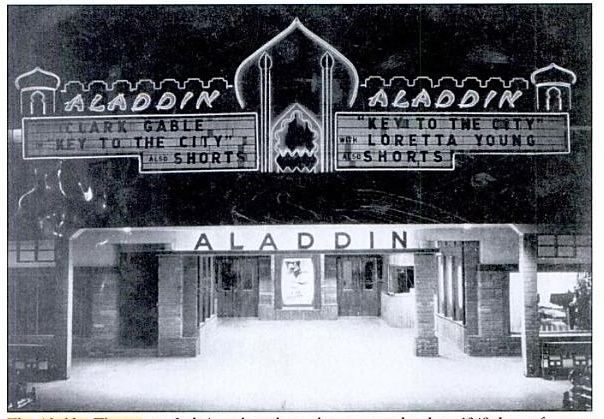
When I was a senior in high school I got a job at the local movie theater, it was called the Aladdin, and was decorated with Arabian style carpets and paintings. I was pretty stoked. I thought having a job at a movie theater was the best of all possible worlds. After all, I liked movies and how hard could it be asking people to show me their tickets?

My duties in the new job included: taking tickets at the entrance, picking up cigarette butts out of the urinal, walking through the theater with a flashlight instructing people to remove their feet from the seat in front of them, urging rowdy children to be quiet, and during Saturday matinees-selling snacks and drinks to the crowds of kids at the candy counter. I didn't get to see that many movies from beginning to end. This was the old Aladdin Theater before it had been subdivided into smaller spaces. So there were a lot of seats to supervise and a lot of cigarette butts to pick up.

Mr. Van Gortel was the manager, an imposing gentleman of some girth. He would come through a couple of times each evening to make sure we were doing our jobs. Every once in a while he would send me behind the movie screen where extra supplies were kept. There was a big storage space behind the screen. The amazing thing to me was that you could watch the movie from behind the screen, albeit in reverse, and smack dab in front of the huge speakers. It was a little like being in the movie, like I could just ride the horses across the stage in once upon a Time in the West, or sing with the Von Traps in the mountains. The less attractive reality behind the screen was the open boxes of popped corn. These were for our busy times when Mr. Van Gortel would bring the already popped corn out and add it to the popcorn being warmed in the popcorn maker in the lobby. If you ever wondered why your movie popcorn was a little stale or chewy, consider this.

Every now and then a fight would break out between some high school boys in the theater. I could usually quell their enthusiasm with my flashlight, or a promise that the police were on their way.

My experience as a movie usher came to an end when I started to make real money as a pool lifeguard. But I’ll never forget my job at the Aladdin, and I’ll never eat movie popcorn again.

Wednesday, July 20, 2011

Going to the drive-in


In the late 1950s my family and I went to a drive-in theater to watch a movie. My father was substituting for the regular projectionist who had taken a two-week vacation. I don’t remember what movie we saw, maybe Walt Disney’s Sleeping Beauty. The whole experience of watching a movie in the car was so unique. We three kids would go in our pajamas so that when we fell asleep in the car, our parents would just have to carry us to our beds upon our return home.

The drive-in was a fascinating experience. With the little metal speaker that would hang in your window, the big snack bar at the back of the space, the playground under the screen for the little tykes before it got dark. And then there were all those people sitting around you in their cars, in the dark. It was as if you were alone in the middle of a crowd.

By the end of the 1960s there were 220 drive-in theaters in the state of California. Today about 20 remain open. Home entertainment centers have changed our lives, but the drive-in experience is a memory that will be hard to erase.

Thursday, June 9, 2011

Grapes


When I was a boy, our home was located in the midst of vineyards, Thompson seedless table grape vineyards, to be precise. I loved these grapes. When you pop one in your mouth it provides an explosion of refreshing flavor.

Viticulture was originally brought to California by Spanish Franciscan friars, who in 1769 began cultivating grapes at California missions in order to produce sacramental wines. It was not until the 1800s that the production of table grapes became popular.

So picture me if you can, a skinny boy of 11 or 12. I would go into the vineyards after the pickers were done. This is what the Bible called gleaning, (Leviticus 19:10), a noble tradition where the pickers would leave some of the fruit on the vine for hungry peasants like me who came along.

I would trundle home with my box of grapes and sit in front of the TV, eating as many of those delicious morsels as I could. I would stuff a handful of grapes into my mouth and chew and swallow while sitting in the cool breeze of the air conditioner. This was a little bit of heaven on a hot June afternoon. Of course within an hour I felt a little bit sick to my stomach. I guess even a little bit of heaven has its costs.

Speaking of costs, prices for table grapes in recent days were approximately $701 per ton. I don’t think I ate a ton of ‘em, but I probably owe someone some money.

Wednesday, June 8, 2011

Exams


In 1989 I took the exams to be a licensed marriage and family therapist. I had spent three years getting a masters in marriage and family counseling, and the license would give me the authority to practice independently in California and bill insurance for my work. I passed the written exam first time, but the pass rate for the oral exam was about 50%. Needless to say I was nervous about coming this far and not making it. I took a prep course that was widely touted as the best in the region. Tom and I were living together by then, so he helped me study my flashcards. By the time the test came around he could tell you almost as well as I whether a concept was Freudian or Jungian, and whether a Satir intervention would work better than a Minuchin intervention with a particular family.

The Oral exam was being held in the Hilton Hotel near Los Angeles International Airport. Since I needed to be there early for the exam on Friday morning, Tom and I went to the Hilton on Thursday night and took a room. I was very nervous. He did what he could to calm me down, shoulder rub, back rub, foot rub; enough said. I was fully prepared and completely relaxed in the morning. The exam went smoothly, I made no obvious errors. And then the waiting began

I don’t know if it’s better today, but in those days waiting weeks and weeks for the results of the exam was just what we had to put up with. It was during that waiting period that we sold our house and moved to San Diego. The idea was if I had passed my licensing exam, I could more easily find a job and make a living for us in San Diego. Tom would be making more money in his new job but it was still necessary for us to be a DINK (Dual income no kids) couple. So we moved into the future on faith, faith that I had passed. When I interviewed for possible jobs I told them that I had taken the exam and was still waiting for my result. I must’ve looked competent. I got a job offer. A month later the test result arrived in the mail.

I passed. I gave Tom full credit… and from time to time you can still overhear him quoting the great therapists of our time.

Ships in the Desert


A month ago my husband and I, along with two of our loyal friends, went to Coachella Valley High School, to join in the celebration of its 100th anniversary. The school's steel reinforced concrete walls look very much like they did when I was in school in the 1960s. One feature I enjoyed even as a student was the way the campus was designed around a collection of connected quadrangles. As I recall, a lot of the student life could be conducted outside in the shade of the quads, because the weather wasn’t oppressively hot until June when school was out for the summer.

During our visit to the campus I was struck again with the design features at the entrance; large concrete structures that sweep up and over the roof look like the superstructure of a ship. And the corners of the buildings are rounded as if to cut through the waves more easily.

My understanding is that the architect of the original Coachella Valley High School was E. Charles Parke. So the design features that reminded me of a ship in the desert came as no surprise. It was E. Charles Parke who designed my grandparent’s home in Thermal in 1939. And that home certainly had some ship-like features. There was a round porthole window in the front door, a second-floor deck that wrapped around the east side of the house, rounded corners on the exterior walls, and a glass brick window in the stairway.

Parke was a Canadian, born in 1886, he became a naturalized citizen of the U.S. and moved to California where he set up offices in Riverside and Chula Vista.

Information about Mr. Parke is thin. I can only guess that the man who grew up in Ontario, Canada, was more accustomed to lakes than sand. But when he encountered the waves of sand dunes in Southern California, he couldn’t resist designing around some nautical inspirations.

Thursday, May 19, 2011

The Floor and I

I grew up in a 900 sq. ft. house that my father had built with the help of his brothers. They installed radiant heating, a series of hot water pipes, in the concrete slab. On cold winter mornings the floor was toasty and warm. When I was 10, I must have weighed all of 65 pounds, and I was frequently cold in the winter. So in the mornings I could be found on the floor in the bathroom where the radiant heating worked most effectively through the linoleum. My sister would pound on the door and shout “Ronnie, get out of there; I have to get ready for school”. Sometimes my brother would join me, and then we were twice as difficult to budge.

In the 1970s I developed a primitive practice of yoga. I learned to take the position of the plow and stretch my legs and back. I was taught in the course of actor training that the floor was my friend. I was encouraged to get friendly with it and know where it was at all times. I’m not sure what actor training is like today, but in those days we spent a lot of time on the floor, being snakes and bears and what have you.

In the 1990s as MS began to impact my locomotion, I developed methods to assist myself. I would lean on furniture and eventually had grab bars installed in the bathroom. But like most humans, I get distracted. One weekend Tom was away from home visiting his mother in Florida. I was transferring from my chair to the bed with the aid of a tall pole installed in our bedroom. I could usually make the transfer in one smooth movement, but my legs didn’t really have the strength to hold me up. So on this particular evening, I pulled my pants off and accidentally slipped to the floor. I couldn’t get back up. I tried to crawl up into the bed, no dice. My arms weren’t strong enough. I thought about spending the night on the floor, I could pull bedding down on top of myself, but I would still have the same problem in the morning unless I wanted to spend three days on the floor. So I reached the phone off my nightstand, and called my next-door neighbor, the San Diego police officer. He came over and got me into the bed, and told me I would be surprised how many times the police get called for similar situations.

I don’t spend much time on the floor anymore. Today most of my transfers are assisted by someone. But if I make a misstep, my old friend the floor is still there, waiting to embrace me with open arms.

High School abuse


When I was in high school in the late 1960s I was the victim of a roughing-up. I had to walk through a long hallway to get from one class to another. I was late to class and found myself the only person walking down the hallway. But there were eight or nine boys lining the walls on each side of me. They were dressed in T-shirts and baggy denim trousers, the 60s version of what might have been called ‘pachuco’ style in the 1940s. As soon as I entered the gauntlet, they closed in on me and pushed me to the ground. Then they scattered my books around and kicked me in the ribs for good measure. As quickly as it all happened it was over and they dispersed. I got to my knees and picked up my books. I realized I could stand and breathe and nothing was all that damaged. I felt fortunate and went on to class.

In retrospect, I was probably the victim of opportunity. The event may have had some racial overtones, or some fashion implications, (because I wore some hideous slacks from JCPenney). All in all I got out of high school without much tribulation. Today when I read the alarming statistics about teenage suicide, I know a lot of it has to do with how teenagers treat each other badly. I know it’s not a new problem but it is a tragic one. A young person might get targeted for having bad skin or speaking with a lisp or wearing hand-me-down clothing. Whatever the catalyst, it’s no excuse for this treatment.

I had so many positive experiences in high school; in sports, in student government, in drama, that my brief encounter with violence was easily shaken off. I shudder to think what would have happened if being jumped was my daily experience, and my primary experience. I understand teenage despair. If a youngster feels different and isolated, it can feel like a lonely prison cell. Spread the good news; after high school it gets better.

See the ‘it gets better’ campaign on YouTube.

Names

I watched a royal wedding recently and I was interested to note the name of the groom. Prince William Arthur Philip Louis. His moniker evokes centuries of history- and a complex labyrinth of family relations.

My father’s name was Ewing Lee Robertson. I once asked my grandmother why she had chosen the name Ewing. Dad was her sixth son, and she said after all those boys she had run out of other names to use. She already had a Harry and a George and a Carl and a Glen and a Gaylon, so when she met someone named Ewing, she thought ‘That would be a nice name for a boy.’

Ewing was a fine man, honest and decent. He always left a place better than he found it. On his deathbed he said to my husband and me that he was glad we’d found each other and he encouraged us to continue taking care of each other.

As a young adult I wondered where my parents had come up with the inspiration for my name. My middle name is Ewing, and I’ve always felt privileged to carry a little bit of my father around with me. But my first name has no obvious familial origins. As a young adult, my politics began coalescing. And I started to worry that my parents had named me after a certain Ronald who had become governor of California. My mom reassured me that Mr. Reagan had never been a hero of hers. Long before him, she was enchanted with the name of another actor, Ronald Coleman. A film critic of his time said this of Coleman:

“For such a gentle man, he had a core of strength, an adherence to his own code of honor like steel - incorruptible and immoveable.”

Need I say more.

I believe that names carry a certain indescribable influence. They imbue a person with certain qualities and they radiate a personality before the person is fully formed.

Our niece and nephew, Jennie and Kevin, had a baby boy last month. He was their third child after giving our family two beautiful daughters, Ainsley and Hadley. I have to admit I was moved to tears when I learned they’d named the boy, Ewing.

Tuesday, April 19, 2011

Hospital Chaplain


When I was a hospital chaplain, I had an uncomfortable familiarity with death. I say uncomfortable because I was 35 years old and far from that significant threshold for myself. I say familiarity because I officiated at more than 60 funerals during those years and I sat by the bedside of many people who were about to die. I responded to the nurses who called every time an infant died. I don’t think any of us ever get comfortable with that. I sat at the bedside of many people who were facing their own deaths. Some of them talked about everything but death. However I distinctly remember some, who on the doorstep to eternity, could speak openly about what they thought and how they felt.

Take for example Rosemary, who was in the hospital for many weeks. She was battling cancer and always appreciated a visit from the chaplain. In my first visit at her bedside she said to me ‘I’m going to die soon.’ As matter-of-factly as if she had said I’m going to have my hair done tomorrow. I admired that kind of confidence, and I spent some time every day for three weeks with her. Rosemary had an easy laugh and liked telling funny stories. She had some worries about how her family would react to her death. But she herself wasn’t worried. I admired her tremendously and tried to carry her confidence with me.

I spent some time visiting the woman with emphysema. This was in the days when a patient could still smoke in the hospital. So wouldn’t you know it -there she was smoking a cigarette. The skin on her face was dry and leathery; she could only speak a few words before coughing. She said to me, “thank you for dropping by Rev. ‘cough cough’ no need for you to stay ‘cough cough’ I’m way past redemption ‘cough cough’.”

A 60-year-old woman was brought into the emergency room bleeding from her femoral artery as the result of an auto accident. She was able to instruct her doctors that she didn’t want any blood transfusions. She was a Jehovah's Witness, and her religion prohibited the use of blood products. This drove the hospital staff crazy. In their eyes it would have been so easy to save this woman’s life. But to refuse blood products seemed to them like sure suicide. I explained to her doctors that she had the right to refuse medical procedures, even when her rationale didn’t make sense to them. They kept her alive longer using a hyperbaric chamber and oxygenating what blood she had left. Eventually she died. Her family was relieved knowing that without blood transfusions she could go straight to heaven. Her doctors were flummoxed.

Throughout those years I considered my parishioners to be the hospital staff. Nurses who were on their feet all day and all night; respiratory therapists who went from lung to lung extending the breath of life where they could; social workers and discharge planners trying to find adequate arrangements for the discharge of very sick people. They were a dedicated and hard-working group, and I was privileged to be held in their loving embrace.

Monday, April 18, 2011

Osso Bucco


Tom made Osso Bucco for dinner a couple of weeks ago. Italian for a ‘bone with a hole’, this recipe calls for a slice of veal shank that gets simmered in broth and rosemary, thyme, bay leaves, clove and vegetables for 60 to 90 minutes. When it is served the Osso Bucco is falling-off-the-bone tender and delicious. The other advantage of this recipe is that when the meal is complete, a beautiful bone is left for the dog. We finished the meal in 40 minutes. Flash has worked on the bone for days. Tom and I sit and watch him try to chew on the inside of the circle. It provides hours of entertainment for all three of us. I know what you’re thinking: “these two are easily entertained.” Yes, we are.


There is something “old world” about this recipe. It takes time to cook, it makes the whole house smell delicious and you can’t eat it while standing over the sink. Don’t get me wrong, I’m grateful for the modern day shortcuts in the kitchen. Without them I’d weigh 80 pounds. But there is also a benefit from the

old recipes. Isn’t there? Am I just being sentimental? At one point in my past, when I had two legs to stand on, I made apple pies from scratch. Piecrust is a tricky endeavor, but when done well it’s a delight.

Flash just showed up to remind me that this piece is not about recipes, it’s about bones. The kind your dog will love.

Band Uniform


I did all four years of my secondary education at Coachella Valley High School, where the mascot was the C.V. Arab. Therefore our band uniforms were appropriate to the Arab culture. I'm not sure it was a uniform that any authentic Arab would recognize; they were more like your Hollywood version of an Arab. The uniform began at the top with a dark green felt fez. In Arabic it's known as a tarboosh. With a tassel attached to the top and hanging down the side, picture Matt Groening’s Akbar and Jeff. (That's probably why I turned out gay-- I was made to dress like Akbar and Jeff during my formative years.) Our shirts were made of gold satin with full sleeves and over that we wore a green felt vest. We wore green wool pants that were gathered in at the ankle. Picture Barbara Eden in I dream of Jeannie. The gold satin cummerbund helped tie the outfit together. My feet were big enough that the toes curled up of their own accord without any help from the costume designer.

The real miracle here was that they dressed three dozen of us in these costumes and put us on a hot street in the Coachella Valley carrying drums and tubas… and most of us survived. I suppose that all of this was good preparation for my years in the theater. I could say to the director in any given play ‘you want me to wear that?’ Sure, no problem.

Tuesday, March 22, 2011

Brokenhearted


I fell in love in my mid-30s and I fell hard. His name was Jay. We met quite by accident and ended up talking most of the evening. He was from out of town and living in my area because IBM sent him there to close down a local facility. The circumstances of his work assignment should have been a warning to me, but you know what they say-love is blind and a little bit stupid. He stayed over that night and for several nights thereafter. Over the next few weeks, we went for long drives and sang in the car. He cooked for me and bought me flowers.

I took him to my grandmother’s funeral where he met all the family. He interacted with my little niece and nephew with grace and charm. He talked with my parents in a way that put his higher education at Cornell to good use. We were both working more than full time, but we spent nearly every night together; he almost never went to the little apartment he had rented nearby. He flew to his home in the Bay Area and rented a truck to bring some of his things back down south. He brought his bed, which he said was more comfortable than mine so we put my mattress in the garage. He brought his big rocking chair, and we settled in to my place like a couple of honeymooners.

One morning I woke up and found him sitting quietly in the rocking chair. I kissed the top of his head and asked ‘is something wrong?’ He said no. That night when I got home his belongings were gone. My mattress was back on the bed. His clothes, rocking chair, brush and comb all gone. I called him at his old apartment and he said he just needed some air. I didn’t understand, I peppered him with questions. Air? Was I smothering you? He said he didn’t know; he just needed some time.

If you want to drive someone crazy don’t give him the complete story. Just give him enigmatic explanations like ‘I need some air’. Well, it drove me a little crazy. I started driving 20 minutes to his apartment at 10 PM at night and sitting in the parking lot trying to watch people coming and going. I knew what grief and depression could do to a person, my life became a prime example. I became sleepless and restless. I cried at unexpected times. I was brokenhearted.

After a month he told me the truth. He had left his lover in the Bay area and eventually came to doubt his decision. I was still a wreck. Over the next few months, through long talks with my friends and my therapist and a lot of rigorous exercise, I made a slow, deliberate climb back into mental health.

This is a dark story in my life that I have resisted retelling. But with time comes perspective. Six months after my fiasco with Jay, I learned that my friend Tom had become single again. I called him and made a date for lunch. As it turned out my heart had been broken… I like to think of it as broken open, to be ready for the love of my life.

My First Home (with a little help from my friends)


In the early 1980s I ventured to purchase my first home. It was a two-bedroom condo under construction. Set up into a hillside, it had a lovely view of the Conejo Valley and the builders promised it would be completed by June. But by the Fourth of July it was still nothing more than 2x4’s. I would go by every couple of weeks and supervise, but that didn’t seem to speed the process at all. After Thanksgiving I learned that construction had stopped because of a lawsuit. Evidently my two-story unit had emerged into the view shed of the homes on the hill behind me. It seemed that my lovely view of the Conejo Valley used to be theirs. In any event I left the builders and the homeowners to sort out this issue without me.

Come spring, the construction started again. And about 11 months after I opened escrow my lovely condo was almost ready for me. The sales office informed me that they would need $5000 in closing costs before I could move in. I said to them “And you are telling me about the closing costs now, after 11 months?” I had never purchased a home before; I was a real estate virgin. So these closing costs came as something of a surprise. I was as likely to come up with $5000, as I was to produce a Polaroid picture of the baby Jesus in the manger. I was very upset to think that a year of hoping and waiting would produce nothing but disappointment.

When I shared my distress with some of my friends at work, they said, “let us help”. So I borrowed $1000 each from five of my colleagues. They were so good about it, I told them I could pay them back with $35 a month. They smiled and said, “Take your time”.

Two years later I sold the condo for a nifty profit. (Oh the beauty of Southern California real estate in the good times.) I was able to pay off my colleagues, and put a down payment with Tom on our new home in Ventura. These friends and colleagues have a special place of honor in my memory. I hope you each have known such friendship in your life too.

Seventh-grade Friends


Beginning seventh-grade made me more than a little nervous. It was in seventh grade that young people in our community first changed clothes for P.E. and showered afterward. In retrospect I was making a mountain out of a molehill, or was it vice versa? As with many young people that age I was insecure about my naked self. I had an ectomorphic frame (tall and skinny) and I had no idea how my personal physical dimensions measured up to my peers. Once we all got in the changing room I undressed so quickly and avoided looking at others I was still pretty ill informed.

The changing room was not the only place I should have been worried about. I had experienced a growth spurt that made it difficult for me to place one large foot in front of the other without tripping. Expecting me to run and throw a ball simultaneously was beyond optimistic.

In 7th grade, we also began moving to different rooms for different classes. So in the course of a single day we changed classrooms, changed teachers, changed clothes. It was a lot of change for a young person. Fortunately I moved to the seventh grade with a band of friends, loyal stalwarts. When I think back I realize I made a lot of difficult transitions, and good friends had eased the way. We expect a lot of our friends and my friends have come through, overlooking my weaknesses and walking shoulder to shoulder through the transitions.